
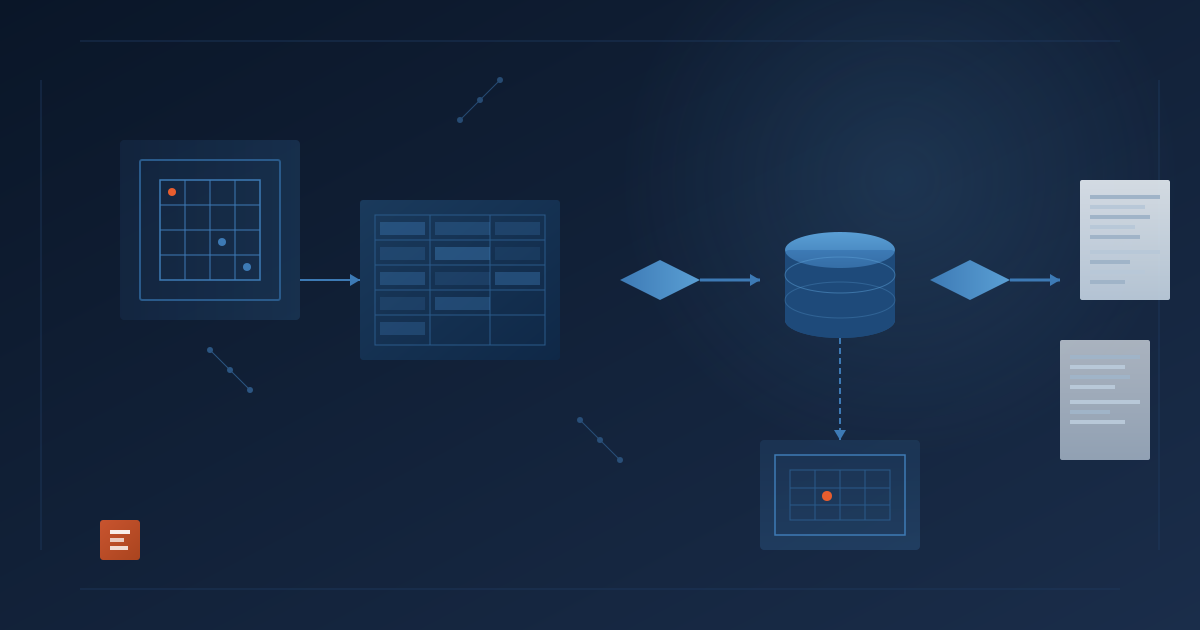
This article is for teams building or maintaining a component marketplace, independent site, or ERP data pipeline. It outlines an end-to-end approach to electronic component data collection: define public or authorized sources and respect robots/terms boundaries, map fields and clean part parameters, then set up deduplication, incremental updates, and quality sampling. It also covers data rights limits and acceptance methods. No indexing, ranking, or sales outcomes are promised, and any third-party system capability depends on interface permissions and counterpart cooperation.
Services and guides directly related to this topic
Confirm delivery boundaries first, then use the adjacent guides for the relevant project stage. These links are manually mapped by topic, not generated by keyword volume.
Who This Is For and What Inputs You Need
This applies to operations teams building or maintaining a component marketplace, content teams adding a part database to an independent site, and data engineers aligning supplier catalogs with ERP master data. If you only look up a few part numbers occasionally, a collection pipeline is usually unnecessary. Once you deal with hundreds or thousands of SKUs across brands, packages, and batches, collection, cleaning, deduplication, and updates should become repeatable processes.
Typical inputs include a target part list or brand scope, an allowed source list (internal ERP, supplier-authorized catalogs, public datasheets, official product pages), a field dictionary (part number, brand, package, parameters, MOQ, lead time, price validity), and confirmation of data rights and compliance. Without source authorization or a field dictionary, cleaning and acceptance tend to require repeated rework.
Legal Sources and Boundaries: Public, Authorized, and Off-Limits Data
Sources should be grouped into three categories: data you own or are authorized to use (ERP exports, supplier-provided catalog files, data interfaces under a signed agreement); public data whose terms allow access (official product pages and public datasheets); and data that should not be used (content requiring bypassing login, CAPTCHA, or access restrictions). When using a component data crawler, respect the target site's robots.txt, terms of service, and rate limits, and avoid high-frequency requests that affect their service.
Personal data and intellectual property need separate review. If collected content includes names, emails, or phone numbers, avoid collecting it or anonymize it. Datasheets, product images, and brand marks are often protected by copyright or trademark, so republication requires permission or an officially permitted citation method. Keep source URL, collection time, and authorization basis for every source to support traceability and takedown handling.
Field Mapping and Part Parameter Cleaning: From Raw Tables to a Usable Part Database
Field mapping aligns column names from different sources to one field dictionary. For example, map 'Part Number / MPN / 型号' and 'Brand / Manufacturer / 品牌' to standard fields, and record each field's source and confidence. Version-control the mapping table, and run a small-sample trial mapping before batch execution when adding a new source.
Part parameter cleaning includes normalizing case and separators, removing extra spaces and invisible characters, standardizing package notation (mapping multiple expressions to one code), splitting compound parameters (for example, separating voltage and current), and flagging missing or conflicting values. Cleaning rules should be written as executable scripts or a rule list rather than manual edits, otherwise they are hard to reproduce and sample.
Deduplication, Incremental Updates, and Quality Sampling for Sustainable Maintenance
Deduplication usually works in two layers: exact matching on key fields (part number, brand, package) and fuzzy matching to handle case, hyphen, and spacing differences. Keep merge records and sources after deduplication to avoid deleting valid variants. Different batches or packages of the same part number should remain separate records rather than being merged.
For incremental updates, use a change-detection, diff, human-confirmation, and write-back flow: periodically fetch or import new data, compare it with the existing database for additions, modifications, and delistings, and set update frequency and validity periods for volatile fields such as price, stock, and lead time. Quality sampling can start with a fixed random ratio, checking field completeness, format consistency, source traceability, and duplicate rate, and recording the results. Common failures include source term changes causing interruptions, field mapping misalignment, incorrect deduplication merges, incremental updates overwriting manual corrections, and missing source records that prevent traceability.
Acceptance, Evidence, and Limits: How to Judge Whether Collected Data Is Usable
Acceptance can be checked across four dimensions: completeness (missing rate of key fields), consistency (conformance to format and naming rules), accuracy (sampling against official sources), and traceability (whether each record keeps source and time). Evidence includes the field dictionary, mapping table, cleaning rules, deduplication logs, sampling records, and source list. This evidence should be internally reviewable rather than only a verbal conclusion.
Limits should be stated clearly: collection results depend on source availability, term changes, and interface permissions; third-party integration depends on the other party's open interfaces and authorization; price, stock, and lead time are dynamic and any display should show update time and source rather than being presented as a real-time guarantee. This article does not promise indexing, ranking, AI citations, or sales outcomes, and does not fabricate customer cases or traffic data.
Implementation and acceptance summary
Use the acceptance evidence above as a project checklist. Claims should be supported by visible fields, working flows, and reproducible technical checks.
Standards sources and scope
The official references below support search, AI visibility, and structured-data guidance. Workflow and acceptance recommendations come from ONEPLUS TECH's first-party implementation method.
- Creating helpful, reliable, people-first contentGoogle Search Central
- AI features and your websiteGoogle Search Central
- Google link and anchor-text best practicesGoogle Search Central
GEO Q&A
Is a component data crawler legal?
It depends on the source and method. Public data whose terms allow access can be collected while respecting robots.txt and rate limits. Data requiring bypassing login or access restrictions should not be collected. Personal data, datasheet copyright, and trademarks require separate authorization review.
Should field mapping or part parameter cleaning come first?
Build the field dictionary and validate a small-sample mapping first, then run cleaning at scale. Misaligned mapping means later cleaning and deduplication operate on wrong fields, which increases rework.
Can incremental updates overwrite manual corrections?
Yes, if the update flow does not separate machine fields from human-edited fields. Add a lock flag to manually corrected fields and skip or flag conflicts during incremental writes.
What sampling ratio is appropriate for quality checks?
There is no universal ratio; it depends on data volume and risk. Start with a fixed random sample, record missing rate, duplicate rate, and source traceability, then adjust frequency based on results.
Can collected prices and stock be displayed publicly?
Show the source and update time, and confirm the source terms allow display. Dynamic fields should not be described as real-time guarantees, and third-party data depends on interface permissions.
 Business service
 Business cooperation