
Component marketplace and data-system guides

Electronic Components Digital Systems Knowledge Base

Practical guidance for component distributors, traders, inventory sellers, and brands covering independent websites, marketplaces, data pipelines, ERP integration, multilingual SEO, and GEO.

中文繁體English

Latest research and implementation Q&A

New articles generated from the weekly topic plan and admitted only after structure, duplication, and evidence-boundary checks.
12
Diagram of a custom electronic component marketplace procurement loop with part database, parametric filters, BOM upload, inventory, tiered pricing, and RFQ modules

How Does a Custom Component Marketplace Connect Part Database, Parametric Filters, BOM Upload, Inventory, Tiered Pricing, and RFQ into a Procurement Loop?

The value of a custom component marketplace is not page count but a connected procurement loop: the part database normalizes entities, parametric filters narrow the search, BOM upload brings batch demand, inventory and tiered pricing support availability and cost decisions, and RFQ handles exceptions and negotiation. This article covers target users, required inputs, implementation flow, acceptance checks, common failures, evidence, and limits.
Read articlecustom component marketplace
Electronic component warehouse shelves with a tablet, illustrating stock inventory field display

How Should a Component Stock Inventory System Present Update Time, Source, Sellable Quantity, Lead Time, and Price Validity to Build Procurement Trust?

Procurement trust is not built by claiming ample stock; it is built by fields that can be checked, traced, and explained. This article defines update timestamps, stock source, sellable quantity, lead time, tiered pricing and price validity, and exception states, and covers implementation flow, acceptance checks, common failures, and limits for component marketplaces, independent sites, and ERP/API integration.

Read articlecomponent stock inventory system
Abstract diagram of two system blocks exchanging inventory and price data rows through an API bridge

How to Integrate ERP with an Electronic Component Marketplace: Inventory, Price, and RFQ Sync

The hard part of ERP-to-marketplace integration is not the connection itself, but agreeing on master data ownership, then defining field mapping, idempotency, and exception compensation. This guide covers who it is for, required inputs, implementation flow, acceptance checks, common failures, and limits across inventory/price sync, component APIs, and RFQ quote write-back.

Read articleERP marketplace integration
GEO optimization for electronic component websites: entity definition, direct answers, evidence, and crawlable internal links

How to Do GEO Optimization for Electronic Component Websites: From Entity Definition to Crawlable Internal Links for AI Search Visibility

GEO optimization is not keyword stuffing but making your component website understandable to AI search engines. This article provides actionable methods across entity definition, LLM Q&A optimization, AI search visibility, evidence and limitations, and crawlable internal links, emphasizing compliance and no guaranteed results.

Read articleGEO optimization electronic components
Illustration of a component stock inventory system interface showing update time, available quantity, lead time, and tiered pricing

How to Build Trust in an Electronic Component Stock Inventory System: From Update Timestamps to Tiered Pricing Transparency

Procurement trust relies on transparent and accurate inventory data. This article covers six dimensions—update time, source, available quantity, lead time, price validity, and exception status—and emphasizes legal data collection and API permission boundaries.

Read articlecomponent stock inventory system
SEO architecture diagram for an electronic component website showing internal links between homepage, brand pages, category pages, part number pages, and FAQs

How to Do SEO for an Electronic Component Website: Search Intent Roles and Internal Linking from Homepage to Part Number Pages

SEO for electronic component websites is not about keyword stuffing but about aligning each page with a clear search intent. This article explains the roles of homepage, service pages, brand pages, category pages, part number pages, articles, and FAQs, and how to use internal linking to guide users and improve part number indexing and long-tail keyword coverage. It includes implementation steps, verification methods, and common pitfalls.

Read articleelectronic component website SEO
Electronic component data collection flowchart showing steps from legal sources to cleaned database

How to Collect Electronic Component Data: A Complete Guide from Legal Sources, Field Mapping, and Incremental Updates

This article provides a practical guide for component marketplaces and independent sites, covering public and authorized sources, Datasheet field mapping, parameter cleaning, deduplication, incremental updates, and quality sampling. All methods are based on verifiable processes, with no guaranteed outcomes.

Read articleelectronic component data collection
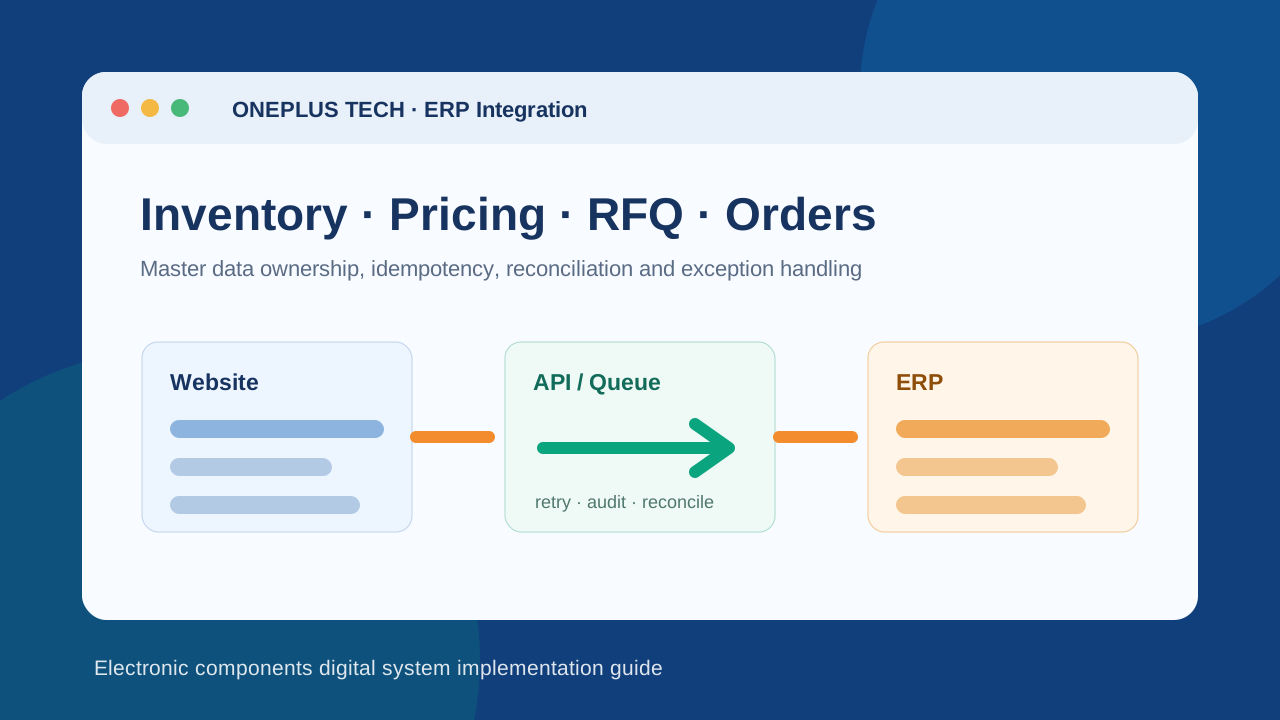
Diagram of ERP integration with electronic component marketplace showing inventory, price, and RFQ sync
How to Integrate ERP with Your Electronic Component Marketplace: A Complete Guide to Master Data Ownership, Inventory/Price Sync, and RFQ Workflow

Successful ERP integration for an electronic component marketplace hinges on defining master data ownership, designing robust field mappings, implementing idempotent operations with exception compensation, and ensuring real-time synchronization of inventory, pricing, and RFQ orders. This guide provides a step-by-step approach from prerequisites to acceptance testing.

Read articlecomponent marketplace ERP integration
Schematic of an electronic component independent site showing part number search, datasheet, and RFQ process

How to Build an Electronic Component Independent Site: Replacing Generic Showcase with Part Number Database, Datasheets, and RFQ Path

An electronic component independent site should not be a generic showcase but be built around part number database, datasheets, and RFQ path to support procurement decisions and inquiry conversion. This article provides actionable insights from applicable audience, prerequisites, implementation steps, acceptance criteria, and common failures.

Read articleelectronic component independent site
Procurement loop in custom electronic component marketplace: part number database, parametric filters, BOM upload, inventory, tiered pricing, RFQ

How to Build a Custom Electronic Component Marketplace That Forms a Procurement Loop: From Part Number Database to RFQ

Custom electronic component marketplace development is not just building a website; it's about creating a closed procurement loop from part search to RFQ. This article breaks down the synergy of part number database, parametric filters, BOM upload, inventory, tiered pricing, and RFQ across six dimensions: target audience, prerequisites, implementation, validation, common failures, and limitations.

Read articlecustom electronic component marketplace
Multilingual electronic component website localization and hreflang configuration diagram

How to Build a Multilingual Electronic Component Website: From Keyword Localization to hreflang Configuration

This article provides a step-by-step guide for electronic component suppliers to create multilingual websites (Simplified Chinese, Traditional Chinese, English), including keyword localization, URL and hreflang setup, translation review, RFQ phrasing, and common pitfalls in GEO optimization.

Read articlemultilingual electronic component website
Illustration of GEO optimization for electronic component websites, showing AI search parsing structured data

How to Improve AI Search Visibility for Electronic Component Websites with GEO Optimization?

GEO optimization uses structured knowledge bases, LLM Q&A optimization, and crawlable internal links to help AI systems accurately understand electronic component website content, improving visibility in AI search. This article provides actionable methods, validation criteria, and limitations.

Read articleelectronic component website GEO optimization

Marketplace architecture and RFQ

Catalog, BOM, RFQ, tier-pricing, and multi-vendor system design.
03

Data, inventory, and part selection

Datasheets, alternate parts, ERP synchronization, and phased site upgrades.
03

Multilingual SEO and GEO

Hreflang, AI answers, long-tail RFQs, brand hubs, and supplier governance.
02

Structured data and sustainable growth

Schema, editorial review, safe templates, internal links, and site migration.
02

Contact ONEPLUS TECH

Positioning: independent websites and marketplace systems for the electronic components industry

Business service: 13267031629Business cooperation: +86 13826519287zyx@dajiqun.comShenzhen One Plus One Electronics Technology Co., Ltd.Room 906, Baoneng Auto Building, Luohu, Shenzhen
Project enquiry

Tell us about your website or system

Share your contact details and priorities. We will follow up about your component website, marketplace, data pipeline, or ERP integration.

Your details are used only to respond to this business enquiry.

Business serviceBusiness service13267031629
Business cooperationBusiness cooperation+86 13826519287