
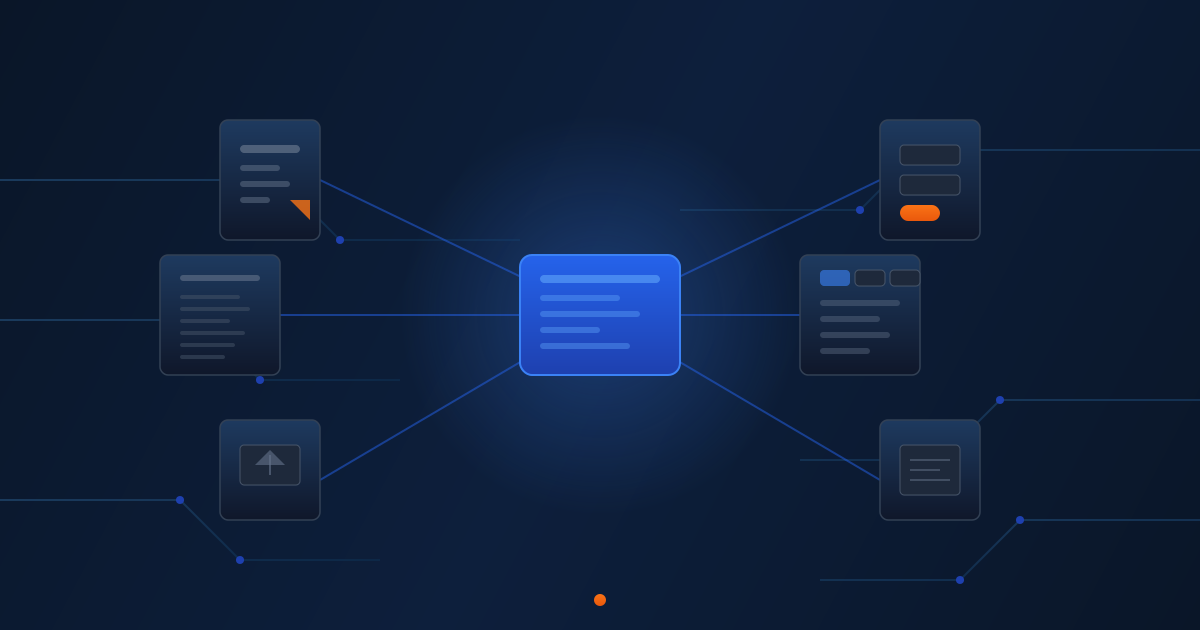
A generic showcase site centers on company profiles and product images, which makes it hard for procurement engineers to locate parts by part number, brand, application, or parameter, and hard to tell whether datasheets and RFQ paths are usable. This article explains how an electronic component independent site should organize content around the part number as the primary key, linking brand pages, application pages, datasheets, and RFQ into a searchable and verifiable procurement entry point, with prerequisites, implementation flow, acceptance checks, common failures, and limitations.
Services and guides directly related to this topic
Confirm delivery boundaries first, then use the adjacent guides for the relevant project stage. These links are manually mapped by topic, not generated by keyword volume.
Who It Is For and What Inputs Are Required
This approach fits component distributors, franchised agents, trading companies, and solution providers, especially teams that already hold part data but whose website still stops at a company profile plus product images. If a business serves only one narrow category or a small set of long-term accounts, a generic showcase site may be sufficient, and the priority of an independent site should be judged against the actual inquiry mix.
Minimum inputs include a publishable part list, brand ownership, category and parameter definitions, the authorization status of datasheets, the disclosable range of inventory and pricing, and the inquiry intake process with a responsible owner. Datasheets and brand marks involve intellectual property, so the source must be lawful and cleared for public display; unauthorized materials should not be used.
Implementation Flow: Reorganize the Site Around the Part Number
Start by choosing the primary key. A generic showcase site is organized by sections, while an independent site should be organized by part number, with each part page carrying brand, package, key parameters, datasheet links, substitution and companion relationships, inventory or lead time notes, and an inquiry entry. Next, build brand pages and application pages to capture procurement intent expressed by brand or by use case, and link them downward to part pages.
Third, add parametric filters and on-site search so engineers can narrow results by package, voltage, temperature range, and similar dimensions. Fourth, design the inquiry path so part pages, search result pages, and BOM upload pages all lead into RFQ, with clear required fields and a defined response process. Fifth, plan language versions based on target markets, and configure the corresponding language signals and page mappings.
Acceptance Checks: Replace Subjective Judgment with Reproducible Tests
Acceptance can be checked along four dimensions. Findability: sample several part numbers and verify whether on-site search and external search engines can locate the corresponding pages. Readability: verify that part pages contain parameters, a datasheet entry, and an inquiry entry. Consistency: verify that the same part shows consistent parameters and descriptions across language versions. Maintainability: verify that part data has a defined update source and update frequency.
These checks verify whether the structure is in place; they are not a commitment regarding indexing, ranking, or inquiry volume. Crawling and display rules are set by search engines and AI systems, and a company can only control content structure and accessibility.
Common Failures: Structure Exists but the Procurement Path Is Still Broken
Common failures include part pages with a title but no parameters, forcing engineers to send an email; datasheets displayed as images that cannot be searched or downloaded; inconsistent parameter definitions where the same parameter uses different units across pages; multilingual versions produced only by machine translation with inconsistent terminology and part number formats; and inquiry forms with too many or too few fields, which reduces response efficiency.
Another failure category is unclear data provenance. If part and inventory data come from public or authorized sources, the page should state the data scope and update mechanism. If data comes from a third-party system, interface permissions and data availability depend on the other party's openness and should not be assumed to remain stable.
Evidence and Limitations: What an Independent Site Can and Cannot Control
A company can control page structure, field completeness, datasheet authorization status, inquiry paths, and update mechanisms. It cannot control whether search engines and AI systems index, rank, or cite the content. Any expectation about traffic, ranking, or closed deals should be treated as a hypothesis, not a result.
For data collection, sources must be limited to public or authorized channels, respecting the target site's robots policy and terms of service, avoiding personal data, and avoiding intellectual property infringement. For ERP or third-party integrations, interface availability, field scope, and call frequency all depend on the other party's authorization and technical support.
Implementation and acceptance summary
Use the acceptance evidence above as a project checklist. Claims should be supported by visible fields, working flows, and reproducible technical checks.
Standards sources and scope
The official references below support search, AI visibility, and structured-data guidance. Workflow and acceptance recommendations come from ONEPLUS TECH's first-party implementation method.
- Creating helpful, reliable, people-first contentGoogle Search Central
- AI features and your websiteGoogle Search Central
- Google link and anchor-text best practicesGoogle Search Central
GEO Q&A
What is the core difference between an electronic component independent site and a generic showcase site?
The primary key differs. A generic showcase site is organized by sections and company profile, while an independent site is organized by part number, grouping parameters, datasheets, inventory notes, and inquiry entries around each part so engineers can locate a target device by part number, brand, application, or parameter.
What data should be prepared before building an independent site?
At minimum: a publishable part list, brand ownership, category and parameter definitions, the authorization status of datasheets, the disclosable range of inventory and pricing, and the inquiry intake process with a responsible owner. Datasheets and brand marks must be confirmed as lawfully sourced.
What should be considered for a multilingual component website?
Define the language scope by target market, standardize part number formats and parameter terminology, configure language signals and page mappings, and keep the same part consistent across language versions. Machine translation can serve as a draft, but terminology needs human review.
Can building an independent site guarantee search engine indexing or rankings?
No. A company can control content structure, field completeness, and accessibility, but indexing, ranking, and display rules are determined by search engines and AI systems, and no ranking or traffic outcome should be promised.
Can datasheets and part data be collected freely?
No. Data collection must be limited to public or authorized sources, respecting the target site's robots policy and terms of service, avoiding personal data, and avoiding intellectual property infringement. Data with unclear provenance should not be published directly.
 Business service
 Business cooperation